Investigations. What the data says. What patients experience.
Deep dives into the gap between population-level trials and individual biology — told through genomic variants, lived experience, and the research that connects them.
Each episode follows one genomic variant — what it does, how it shapes your biology, and what that actually means for how you feel, eat, and move. Told in plain language. Grounded in mechanism.
Episode 01 · Diaries of a Variant
MTNR1B: The Darkness Keeper
Circadian rhythm · Glucose timing
One variant changes when your body clocks in for metabolic work — shifting your glucose window in ways that have nothing to do with what you eat and everything to do with when. This is what MTNR1B does, and why it matters.
Now on YouTube
Coming next
02
Fixed Dosing
CYP3A4 & drug metabolism
03
The Satiety Gap
FTO & hunger signaling
04
Iron's Hidden Role
TMPRSS6 & absorption
The trials were designed to measure everything except what patients were living through.
From The Untold GLP Story — below
Research carousel
The Untold GLP Story.
What 125 clinical trials with 70,000 participants missed — and what one enrolled subject's body made impossible to ignore. A mechanistic investigation into the downstream consequences that trial design couldn't see.
Slide 1 of 13 — Cover
1 / 13
← → arrow keys also work
Insulin resistance is present in most people with Type 2. But present is not the same as primary.
From The Phenotype Problem — below
Research note · Mechanism review
The Phenotype Problem.
"Insulin resistance causes Type 2 diabetes."
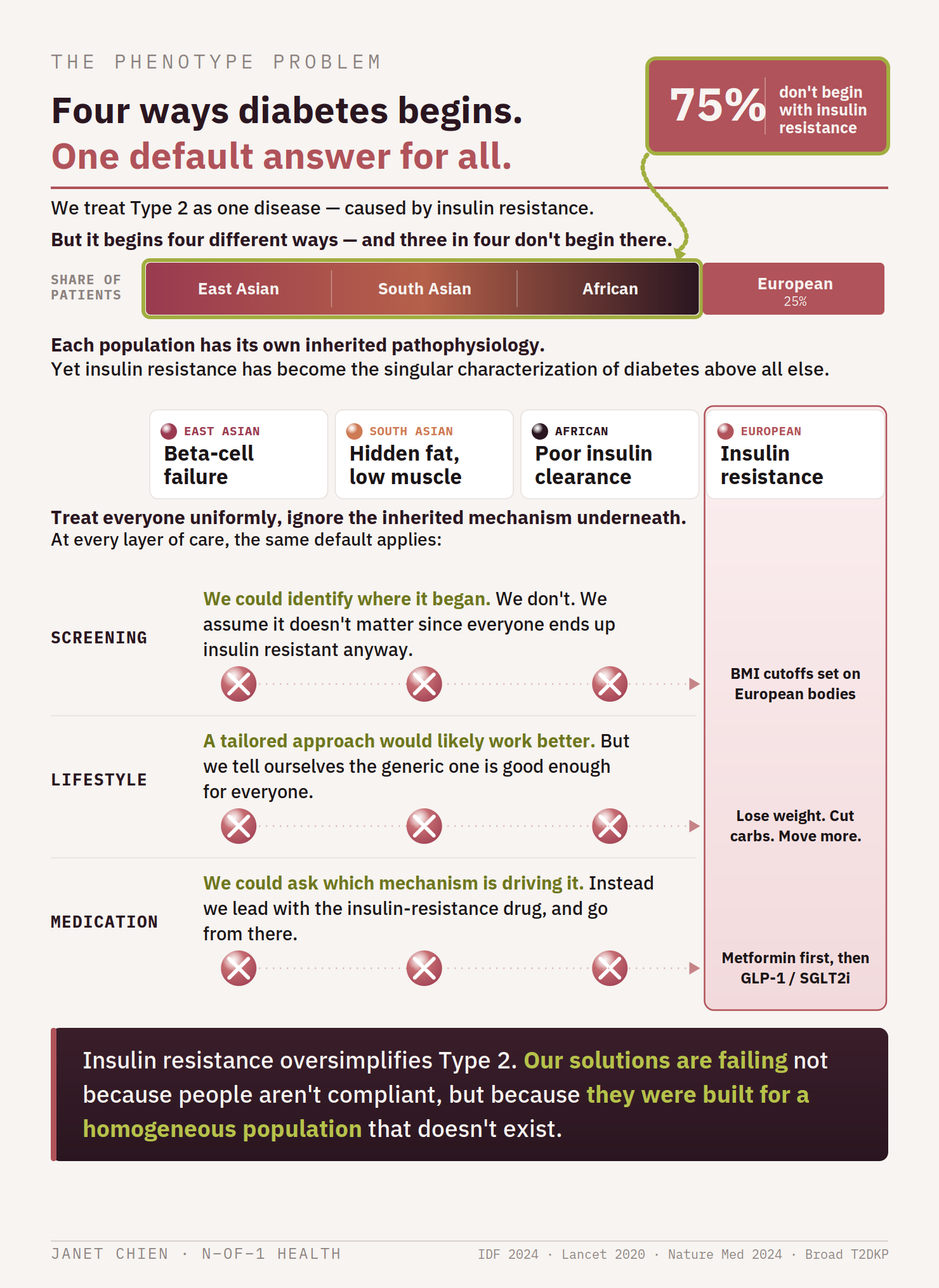
I find a lot wrong with this statement. It discounts the pathogenesis of diabetes for at least 75% of those with the condition.
Following this narrative, it presumes that lifestyle excesses got you where you are. And while that's true for some, it's not true for the majority.
It's no wonder we're failing — diabetes and metabolic disorders keep rising even as the indicators show that excesses like sugar consumption have been decreasing, not increasing, in the U.S.
The Phenotype Problem — four mechanisms, one default
Click to enlarge
We've seen the profound success of precision medicine in oncology and rare disease — yet in our most prevalent and costly chronic conditions, it's rarely applied. A breast cancer patient will likely know whether they carry the BRCA gene, and it will shape their treatment plan. A Type 2 diabetic will rarely know whether they carry a beta-cell signaling defect like KCNQ1 — one that would make an insulin-resistance treatment plan largely miss the mark.
That information is available for under $100 through consumer DNA testing, and the phenotype classifications that make meaning of those variants are available through sources like the Broad Institute's public Type 2 Diabetes Knowledge Portal (T2DKP).
We'll start making real inroads against diabetes not with the one-size-fits-all fat narrative, but when we treat it as a genetic disease — with lifestyle and treatments targeting the underlying pathogenesis.